When we look at the meaning of the word wad from its most basic level, wad means "to drive," to move something forward along a path. But even here, the meaning is already deeper than it looks. It's not just movement, it's movement with direction. Something is being carried, guided, almost pulled toward a destination.
Now, if we break the word down further, wad itself can be seen as composed of wa and ad. These are monosyllabic elements that each carry meaning on their own, and when they come together, they form something more complete. When separated, each becomes a monosyllabic unit with its own distinct meaning, and when brought together, they form the deeper sense of the word.
Wa in Somali refers to a beginning, but not just any beginning. It points to the inception behind the beginning itself. Not the first spark of light, but the force that causes that spark to emerge, the impulse that brings something into existence.
Then you have ad, which carries the sense of "to go toward," or to move in the direction of something.
So when combined, wad can be understood as "to move toward the origin, towards our essential emergence," or "to be driven back toward the beginning from which one came." It is not just movement, but a return-oriented movement, guided toward a source.
Now when a person dies, they do not simply disappear in this framework. They transition. They become part of what came before, they become an ancestor. In that sense, they are no longer within the state of wa (emergence and presence in this world), but move into aw.
Aw can be understood as the reversal of wa, both in sound and in meaning. If wa represents coming into being, then aw reflects a withdrawal from that visible state.
In Somali, aw appears in words that carry the sense of absence, loss, or something that is no longer present among us. A common example is aawey, which expresses that feeling of something missing, something that once existed but is no longer here. But aw is not just absence in a simple sense. It also carries a layer of reverence. It points to what remains through memory, through lineage, through a kind of spiritual continuation.
This is where the word awoowe becomes especially meaningful. On the surface, it is translated as "grandfather" or "ancestor," but when you look closer, it holds a deeper structure.
If we break it down, we begin with aw, that which has left our visible presence. Not erased, not gone entirely, but no longer within the immediate world of the living.
Then comes wo. Wo is another expression of wa, but this does not indicate just any beginning, but a collective one. The o carries a sense of plurality. It suggests not a solitary return, but a joining, a re-entry into a space where many others have already arrived or arriving simultaneously. It is the beginning of another state of being, one that is shared. In this sense, aw is the departure from our presence, while wo is the entrance into a wider, communal existence.
So there is a movement taking place: from singular presence here, to collective presence elsewhere.
And then the word closes with we. In Somali, endings with e often carry a sense of openness or indeterminacy. Something not fully fixed, not fully graspable. It points to what lies beyond clear definition. So we here reflects a becoming, an entry into a state that is not fully known, not fully describable within the limits of our current understanding.
So when you bring it all together, awoowe is not just a title. It becomes a quiet philosophical statement.
- Aw — Absence or leaving our presence
- Wo — entering a shared beginning among others
- We — becoming within a realm beyond our full knowledge
It suggests that what we call death is not a disappearance, but a transition. A movement from the visible to the unseen, from the individual to the collective, from the known into something that continues, even if we cannot fully comprehend it.
But importantly, something can only be described as aw if it once existed. You cannot speak of absence where there was never presence. So aw is not non-existence, it is the absence of something that has already been part of existence.
So when someone dies, they are not reduced to nothing. They move from wa to aw, from presence to absence, from emergence to return, and in doing so, they enter the state of ancestry, becoming part of what preceded the living.
The Triadic Cosmology of Pre-Islamic Somali Thought
In pre-Islamic Somali logic, the world was not conceived through a binary framework — not structured around opposing forces, ones and zeros, or simple duality. Instead, the world was understood through a trinity of principles. This concept, it should be noted, predates Christianity and the broader Abrahamic tradition; indeed, it is arguably one of the conceptual sources from which the biblical notion of a triune God derives.
These three foundational principles were each associated with a color: black, red, and white.
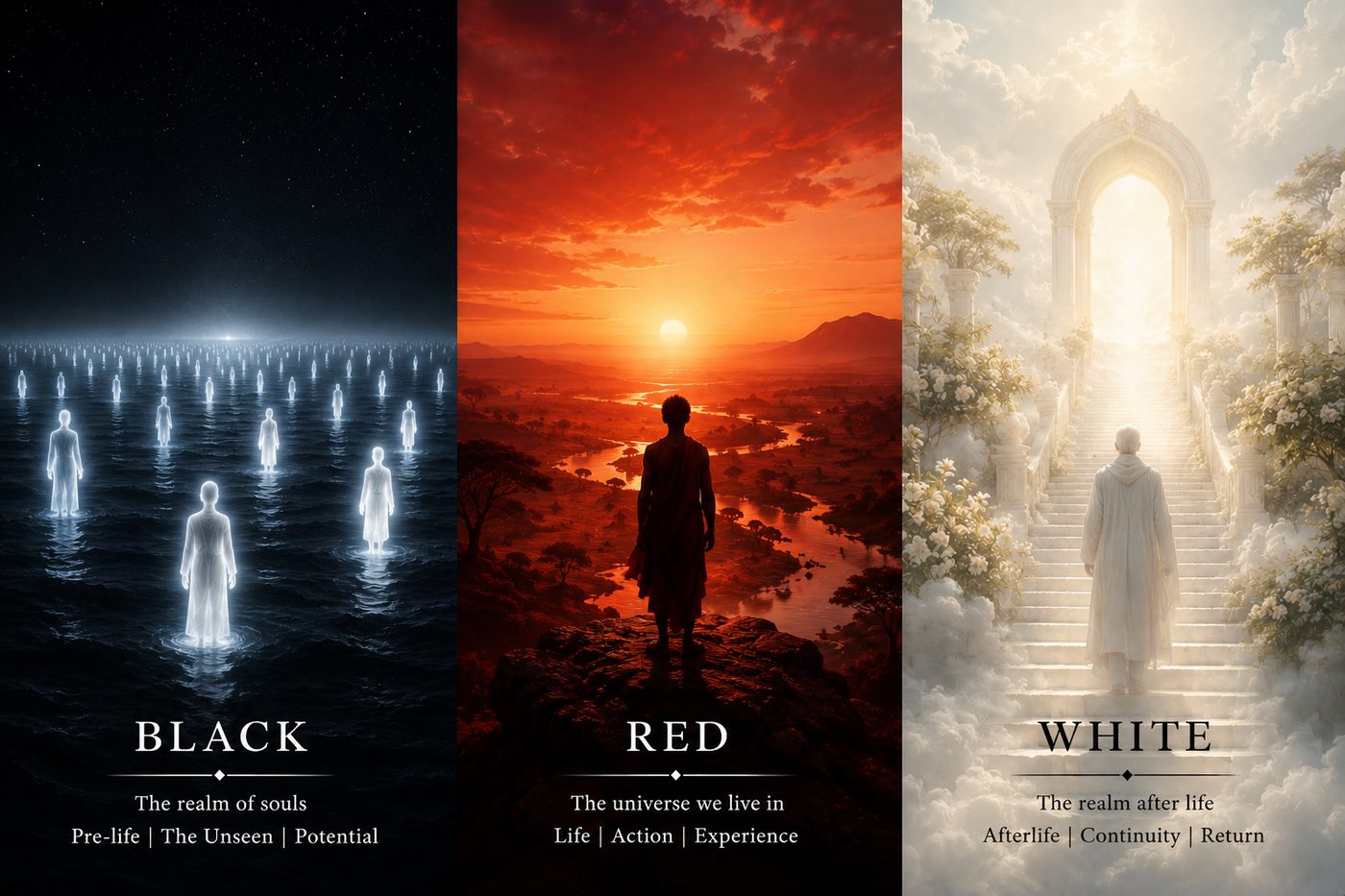
Black represented everything positive and life-giving. It was the color of femininity, of the womb, and of pre-existence, the state before life enters the world. By extension, black was also the color of infancy and childhood, since babies, still innocent and believed to be spiritually connected to the womb, remained linked to that primordial, pre-life realm.
Red — known in Somali as Geduud — became the color of youth and adolescence. It is the color of war, fire, energy, chaos, and ferocity. A common error is to conflate Geduud with Casaan, but the two are distinct: Casaan means reddish-pink, whereas Geduud means red proper. Etymologically, Geduud derives from ged-, meaning nature, and -uud, meaning flame or flaming, thus, "the flaming nature." This color also serves as the symbol of the universe itself, since every solar system, every galaxy, and every living being depends on a star — a burning source of heat and light. Because the universe is defined by light, and that light is fundamentally fire, Guduud becomes emblematic of the cosmos as a whole.
White was the color of old age, death, and departure. It represented everything non-living, the bad omen, the threshold of leaving this world.
This same three-part logic also appeared in how Somali people understood the human life cycle and the lives of living things in general. Babies naturally begin with black hair, which matches black's connection to life, birth, and the beginning of existence. As people entered youth and adulthood, they would dye their hair red, connecting themselves to the fiery and energetic stage of life. Then, when they became old, they would stop dyeing their hair and allow it to turn grey or white naturally. This was seen as a sign that the person was slowly approaching departure from this world.
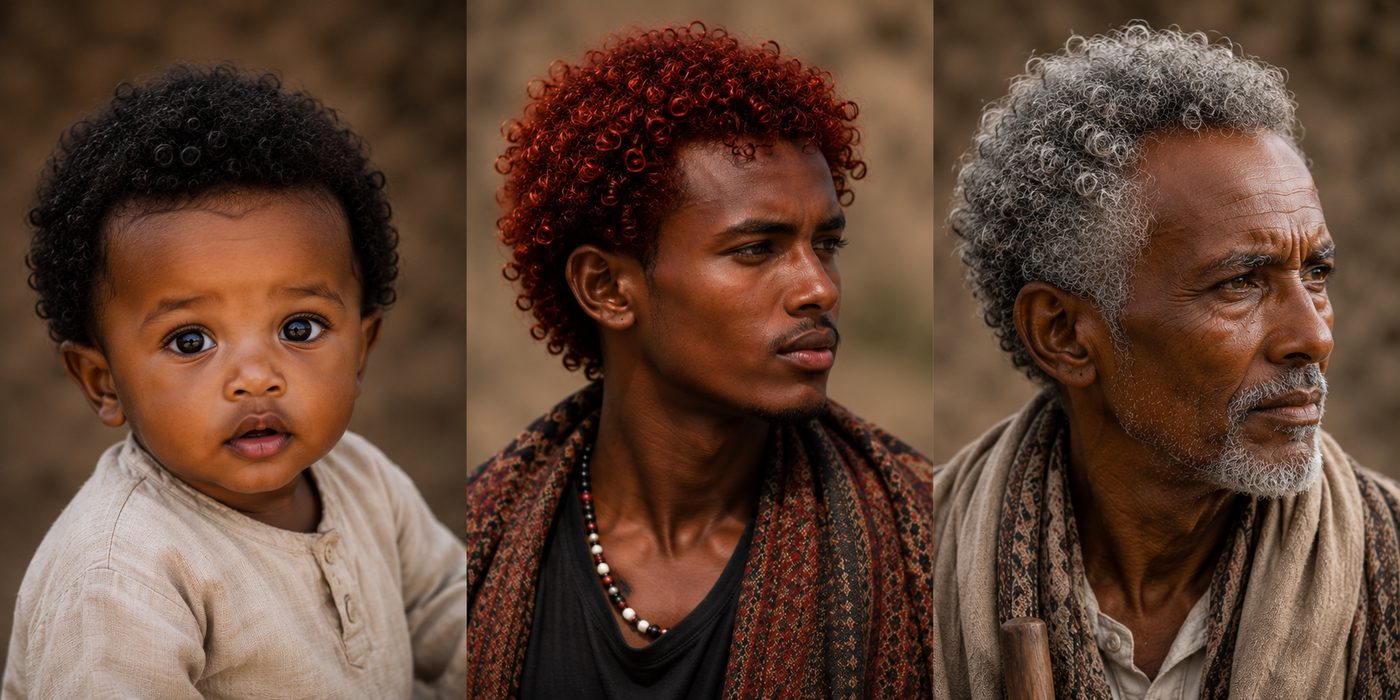
This is also the reason why grandparents are referred to as Aawwe. The word carries within it the sense of imminent or eventual absence: aw suggesting absence or departure, wo evoking entry into a shared origin among others, and we denoting passage into a realm beyond full human knowledge. If an elder has already passed, the name signals that their departure has come to pass. If they are still living, the grey hair and the name together serve as a reminder, tender and honest, that they will soon no longer be among us. They will become Aw: absent, departed, no longer here.
This triadic color system also maps onto the cycles of the natural world — and nowhere more clearly than in the Somali calendar of seasons.
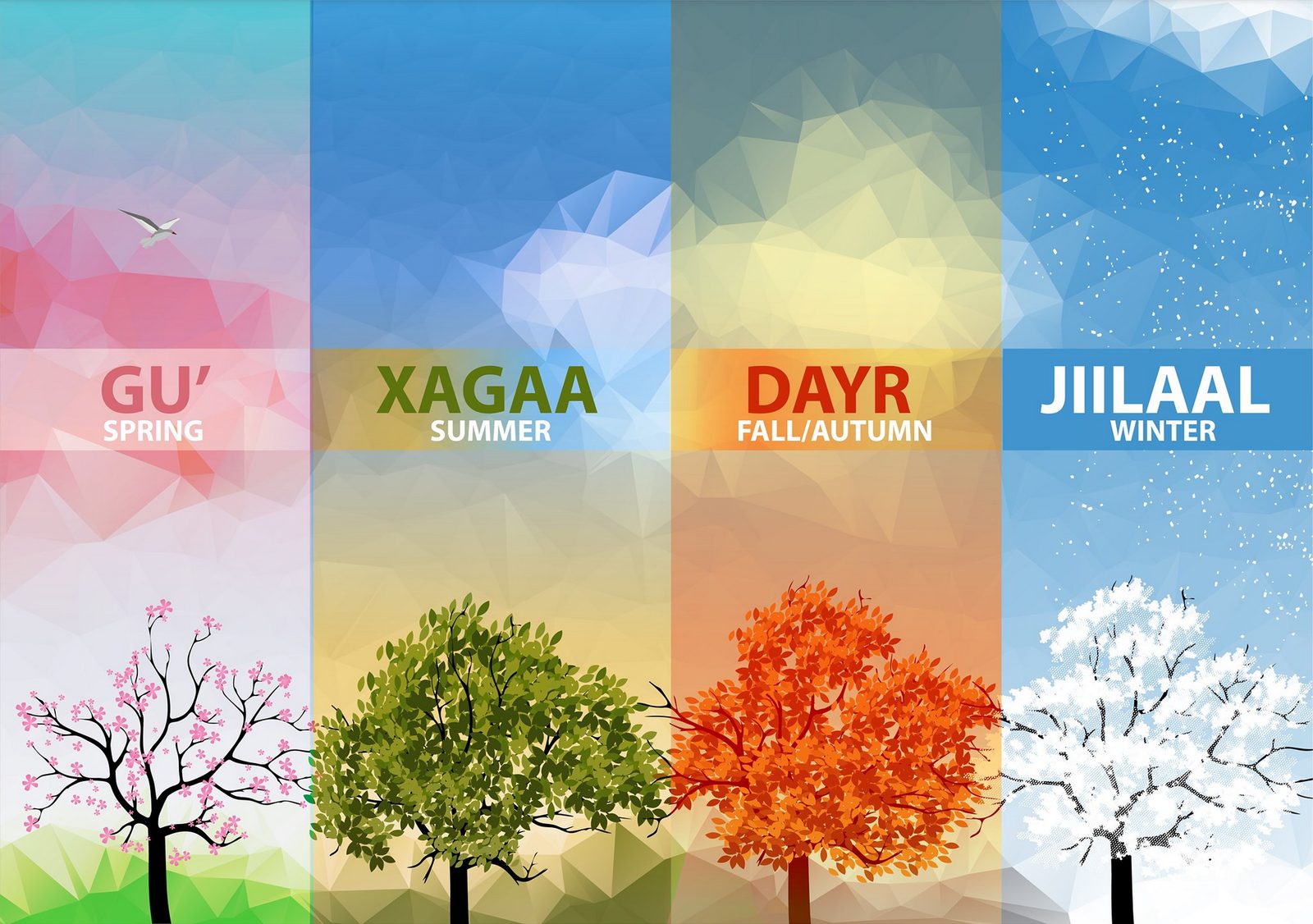
Gu', the spring, corresponds to black: the season of rain, renewal, and abundance, when life re-emerges and the earth is at its most fertile and life-giving. Xagaa, the summer, corresponds to red: the hot, dry, blazing season of Guduud, full of heat and intensity. Then come Dayr, the autumn, and Jiilaal, the harsh winter both corresponding to white: the seasons of dying back, scarcity, and cold, when the world withdraws toward stillness and dormancy.
The same pattern appears in the life of a tree. In the Gu' season its leaves are full and green, and here, green becomes associated with black, both sharing the quality of vitality and flourishing. As Xagaa peaks, nature becomes ever so green and as it fades, the leaves turn reddish-orange, blazing briefly with the energy of Guduud as we enter Dayr and Jilaal. Then, through Dayr and into Jiilaal, they wither into grey, the white of departure and dormancy.
The same logic is visible in charcoal. Before it is lit, it is black, latent, full of potential, in its pre-active state. As it burns, it becomes red, consuming, radiating, ferocious in its heat. And when the fire dies, what remains is grey ash: inert, spent, departed from the living process.
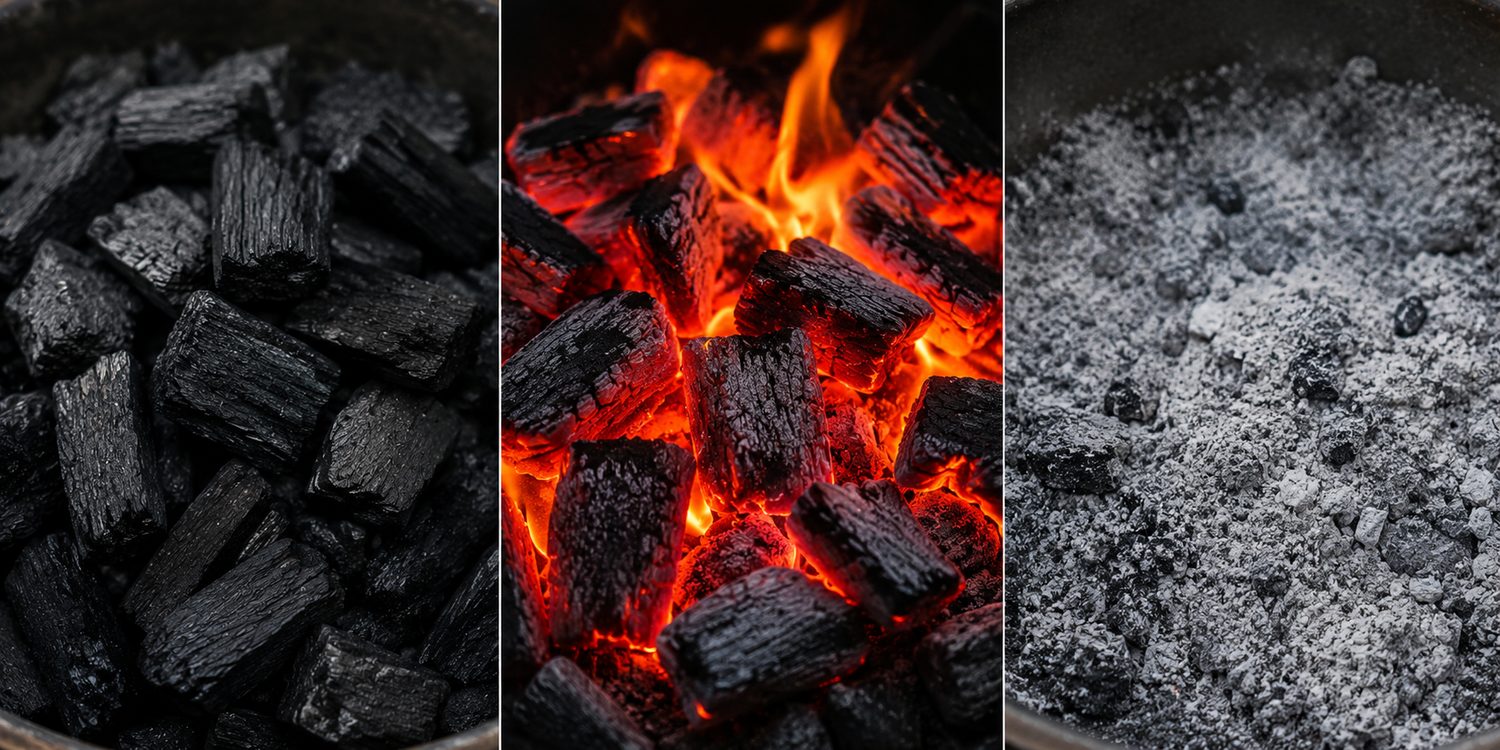
In each of these examples, the three colors do not merely describe stages, they are the stages, recurring patterns woven into the structure of nature itself. The framework is not abstract theology but an observational cosmology, drawn from the world as it actually behaves: things are born, they burn, and they dissolve. Black, red, and white. Life, energy, departure.
And if all of this were to be distilled into a single word, that word would be Wad.
Wad is the driving force, the motion itself, the ceaseless animation that moves all things through their cycles. It is what carries the tree from Gu' to Xagaa to Jiilaal, what pushes the charcoal from black through red into ash, what draws the child from the womb into youth and the elder toward departure. The turning of the seasons, the burning and dying of flame, the greying of hair, all of it is Wad: motion, cycle, becoming.
And behind this motion is its source: Wadde — the Primal Mover, God.
Wadde is not the wind. Wadde is not the fire. Wadde is not the rain or the sun or the turning of leaves. Rather, Wadde is the force behind the moving, the animating principle within all of creation. When the wind blows, God is not the wind itself but the motion of it, the invisible impulse that sets it in motion and sustains its movement. God is the animation within all things, not to be confused with the things themselves.
In this conception of pre-Islamic Somali cosmological thought, divinity is not a distant creator who fashioned the world and withdrew, nor simply a force of nature to be identified with any single element. Instead, God permeates creation as its very aliveness, present wherever there is movement, change, or cycle. Wad is the word for that motion. Wadde is the name of the one who drives it.
Wadde is not the one who drives it from without, Wadde is the driving. The motion itself is God.
Not a God who stands behind creation and pushes it forward as a hand pushes a wheel, but a God who is inseparable from the animation of all things, present not beside the movement, but as the movement. The wind blows, and that blowing is God. The seasons turn, and that turning is God. The flame rises and dies, and that rising and dying is God. Wadde is not a remote architect. Wadde is the pulse within existence itself.
Wadde is not the object, but the animation of the object. Not the wind, but the blowing. Not the fire, but the burning. Not the tree, but the growing. God is the verb within every noun. And Wad is the will of God in action.
Wad: The Root of Motion
Now that we understand the fundamental meaning of Wad, let us return to the word itself, and unpack it further.
The word wad can be understood as a fusion of two elements: wa and ad. The element ad carries the sense of movement, "to go toward," a directed motion aimed towards somewhere. When joined with wa, the expression deepens. It begins to evoke not just movement, but the unfolding of time itself: a continuous, directed motion through which change comes into being. In this sense, wad reflects a cosmological principle, the movement inherent in all things, through which all things are transformed.
One might reasonably ask: if the etymological breakdown of wad is wa + ad, why does the word not appear as Waad? The answer lies in the nature of the Somali language itself. Many older or longer words have naturally compressed over time, sounds fall silent, letters drop, and words shorten for ease of speech. Banaan, for instance, can be traced back to an earlier form banban, where repetition once carried the sense of vastness; over time the sounds simplified, vowels stretched, and the word evolved. Waad becoming Wad follows precisely this same pattern of linguistic compression.
Yet sometimes both forms survive, and when they do, they do not simply repeat one another. Instead, they distribute meaning between them, each capturing a different dimension of the same root. If Wad stands for motion itself, the cycle, the driven course of existence, then Waad becomes what unfolds within that motion: the cause and the effect, the action and its unfolding. Wad is the river. Waad is the current moving through it.
Waad: Motion as Lived Experience
If Wad is motion contained and whole, the driven cycle of existence itself, then Waad is that same motion as it is actively experienced: unfolding, ongoing, or arrived at completion. Bringing the two elements together, wa + ad → waad, one can read it as movement into becoming: a state that is actively unfolding, actively being realised. The Somali language itself bears this out across a range of everyday expressions.
Waad samaysay — you did it. Read through this lens, it reflects a completed transition: you were once in a state of not-doing, then you moved into doing, and now you have arrived at completion. It is becoming that has reached its end.
Waad samaynaysaa — you are doing it. Here the becoming is still in motion, still unfolding, still being carried forward. The sense of ad as direction remains active and alive.
Waan sameeyey — I did it. On the surface a simple declaration, but the word waan itself appears to carry a compressed history. Its original form was likely waadne sameeyey, where waad — motion — is joined with -ne, meaning "me." Over time, the d fell silent, and waadne contracted into waan.
The parallel construction makes this visible. When someone else is asked whether they too have done something, the form shifts to waadna sameesay, here waad, the motion, joins with -na, meaning "you." The d remains audible because the following syllable keeps it supported. But when turned inward — when the motion refers to oneself — waad + -ne compresses into waan, the d absorbed and silenced by the softer -ne that follows.
So across these forms, a consistent architecture emerges:
- Waad — the motion
- -ne — me → waan sameeyey: a previously active cause and effect motion, as experienced by me
- -na — you → waadna sameeyay: a previously active cause and effect motion, as experienced by you
What looks like ordinary grammatical inflection reveals itself, on closer inspection, as something far more intentional: the subject is not simply attached to the verb — they are positioned within the motion itself.
Waad taqaan — you know. A state that has already been reached. The movement has settled; the becoming has come to rest in knowing.
Waad gelaysaa — you are entering. Perhaps the most transparent of all: the becoming is explicitly directional. You are in the process of crossing into another state, another space. The entry itself is the becoming.
Across all of these, waad operates as a single underlying structure: becoming plus direction.
When connected back to Wad, things become even more layered. We have already established that Wad reflects time, motion, and cycle, the driven course of existence. In that light, Waad can be understood as an expanded or active expression of the same root, now applied to lived action. Wad is motion as an idea, contained, whole, and cosmic. Waad is motion as it is experienced — ongoing, unfolding, or brought to completion in a particular act.
Also, in the Somali language, the word ad in wad-ad carries a depth of meaning that cannot be reduced to a simple definition. At its core, it refers to knowledge, but not just any kind of knowledge. It points to expertise, to mastery, to a level of understanding that has been reached through effort, repetition, and lived experience. It is the kind of knowledge that shapes a person, not just something they hold in memory. When someone is described through ad, they are not simply informed, they are refined. They have engaged with a field long enough for it to become part of who they are. This is why ad is best understood as mastery itself, being an expert in something that has been deeply learned and internalised.
At the same time, ad also carries the meaning of movement. In everyday Somali speech, it is used to direct someone, halkaas ad, go there; dukaanka ad, go to the shop. So within the same word, you find both the idea of expertise and the idea of going. At first, these meanings may seem unrelated, but when examined more carefully, they reveal a shared foundation. You cannot reach mastery without movement. Even if the movement is not physical, it is still a process of transition, from not knowing to knowing, from inexperience to expertise, from distance to depth. Movement here is not just about space, but about transformation.
This is not unique to Somali. Even in English, knowledge is described through the language of movement. We say seeking knowledge, pursuing understanding, searching for truth, going toward understanding. These are not accidental expressions; they reflect something essential about how knowledge is experienced. It is not something that simply appears. It is something approached, something gradually entered, something that unfolds as one moves toward it. Somali, however, compresses this entire process into a single expression. Instead of separating the act of going from the state of knowing, it binds them together in ad, making it both the journey and the mastery that comes from that journey.
This becomes even clearer when you look at related Somali words. Garad refers to a person of wisdom, someone who has depth in understanding, someone recognised for their judgment and insight. In this sense, garad is an expert in wisdom. Colaad refers to someone skilled in war, an expert in that domain, someone who has moved through its discipline and internalised its patterns. In all of these cases, ad is not static. It carries the memory of movement within it. It implies that the person has gone somewhere intellectually or practically, and that their expertise is the result of that journey.
When this understanding of ad is brought into relation with the word wad, it produces the word wad-aad, and from this perspective, the word wadaad takes on a much deeper meaning. It is not simply a label for a religious figure, nor is it limited to a social role. It describes a person who has directed themselves toward the understanding of wad. A person who has engaged with the movement of existence, who has reflected on the cycles of nature, and who has not stopped at observing the world but has sought to understand what moves it. This is not just knowledge of visible things, but a search for what lies behind them, the force that animates, orders, and sustains.
In this sense, wadaad can be understood as an expert of Wadde, the primal mover of the universe. So by studying the fundamental forces of nature, by reflecting on motion, time, and transformation, the wadaad moves beyond surface knowledge and begins to understand the divine itself. Not just knowledge of creation, but knowledge of what animates creation.
So what ad reveals is that expertise is inseparable from movement, and what wad reveals is that movement is the foundation of existence. When these are brought together, wadaad emerges as a person who has entered deeply into both, someone whose understanding is not detached from life, but shaped by the very motion that defines it, and who, through that understanding, becomes aware of the primal force that drives all things.
Other related words include:
In waddo — the path — you see Wad as the thing that carries you forward. The path is not passive terrain; it is directed movement given form.
In wadne — the heart — you see Wad joined with the suffix -ne, meaning "me," yielding "that which drives me." The heart, in this framework, is not merely an organ. It is your internal driver — the force within you that sustains your movement, keeps you alive, and carries your journey forward.
Another related Somali expression appears in the way death is described, where wad is invoked indirectly. One might hear phrases such as wadkiisa ayaa dhacay, wadkiisa qabtay, or wadkiisa la kulmay. On the surface, these are often translated simply as "he died," but in reality, they carry a far more precise and layered meaning, pointing not just to death as an event, but to the completion of one's course, one's wad.
Wadkiisa means "his wad", his path, his driven course, his portion of motion. So when one says "his wad has caught up to him," it is not about something external seizing him. It is about completion: the same force that carried him all along has now reached its end with him. When one says "he met his wad," it carries the sense of arrival, not interruption, but fulfilment, as though he has reached the place he was always being guided toward. And when one says "his wad has ended," it means the motion itself has ceased. The driving force no longer pushes him forward.
Death, in this framework, is not an intrusion from outside life. It is built into the same system as life. The very force that moves you is the one that completes you.
When placed together, the full structure reveals itself with an almost poetic precision:
- Wadde — the Primal Mover, the divine force that drives all existence.
- Wad — time and cycle; the motion through which change unfolds.
- Waddo — the path along which that motion is lived and experienced.
- Wadne — the heart, the inner force that drives and carries you.
- wadkaada — your wad — is your share of that movement: your portion of time, your path, your particular journey within the greater cycle. It is not merely that a person dies. It is that their path has been completed. Their motion has reached its end. Their journey has returned them to where it began.
- Waad — is that same motion as it is actively experienced: unfolding, ongoing, or arrived at completion; waad is what unfolds within wad: the cause and the effect, the action and its unfolding.